

Quick answer
Short-finned pilot whales are the resident species in Tenerife waters, visible year-round off Los Gigantes with sighting rates above 90 percent. Bottlenose dolphins appear on most trips. Fin whales, Brysde's whales, sperm whales, and occasionally orcas migrate through the channel between March and May, while rough-toothed dolphins and striped dolphins patrol deeper zones during summer months.
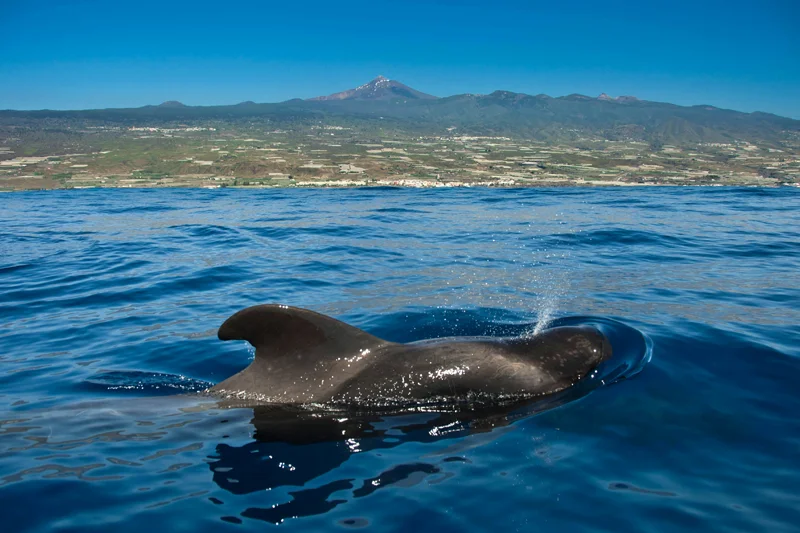
The Teno-Rasca marine strip off southwestern Tenerife shelters a permanent population of around 250 short-finned pilot whales, making what whales are in Tenerife less a seasonal question than a geographic one. These long-finned cetaceans form matriarchal pods of 15 to 30 individuals and hunt squid along the submarine canyon that drops to 2,000 meters less than two kilometers from the Los Gigantes cliffs. Boats leaving Marina Los Gigantes encounter pilot whales within 20 minutes on most mornings, and the species' resident status has earned the zone Special Area of Conservation designation under EU law. Bottlenose dolphins share the pilot whales' range and appear on roughly 80 percent of excursions, often bow-riding in groups of five to twelve. Striped dolphins and rough-toothed dolphins favor the outer edge of the trench and show up less predictably. The deeper water also draws baleen whales during spring migration: fin whales pass through in March and April, Brysde's whales follow warmer currents from late winter into early summer, and sperm whales surface between dives that can last 45 minutes. Orcas appear sporadically, typically in late spring when bluefin tuna run north through the Canaries. Understanding Tenerife whale species helps set realistic expectations for a two-hour boat trip. Pilot whales and bottlenose dolphins are near-certainties; the larger baleen whales require luck and timing. Captains working out of Los Gigantes communicate sightings by radio, and morning departures between 08:00 and 10:00 benefit from calmer sea states and higher marine activity. The resident population means that even outside migration windows, cetacean sightings remain consistent. Excursions operate daily from Marina Los Gigantes, with tickets priced at 28 EUR per adult for a standard two-hour whale-watching trip. Boats depart throughout the day, though early slots offer better visibility and sea conditions. The marine reserve's proximity to shore and the pilot whales' predictable behavior make Los Gigantes one of the few European departure points where what whales are in Tenerife can be answered with a sighting rather than a possibility.
“Short-finned pilot whales form matriarchal pods along the Teno-Rasca submarine canyon, where the seabed drops to 2,000 meters within two kilometers of the Los Gigantes cliffs.”
What Whales Are in Tenerife: Resident and Migratory Species
The Teno-Rasca Marine Strip between Tenerife and La Gomera serves as a critical habitat for diverse cetacean species. These waters support both stable resident populations and seasonal migratory visitors throughout the year.
Short-finned pilot whales are permanent residents
A stable population of short-finned pilot whales resides in these waters year-round, making sightings highly frequent for observers. These animals are social and often travel in pods near the Los Gigantes cliffs.
Twenty-eight cetacean species recorded in Canary Islands
While resident pilot whales are the primary focus, researchers have documented twenty-eight different species of whales and dolphins within the Canary Islands archipelago. This biodiversity results from the deep, nutrient-rich waters surrounding the islands.
Migratory baleen whales pass through seasonally
Various migratory species, including sei whales, fin whales, and blue whales, transit through these waters during their seasonal movements. These larger baleen whales are spotted less frequently than resident species but remain a part of the local ecosystem.
Bottlenose dolphins maintain resident pods
Common bottlenose dolphins are frequently observed alongside pilot whales in the Teno-Rasca area. They exhibit diverse social behaviors and are often seen interacting with tour vessels in coastal zones.
Sperm whales visit deep-water channels
Sperm whales utilize the deep channels between islands for feeding and transit. These marine mammals are known for their ability to dive to extreme depths in search of squid, which thrive in the local submarine canyons.
Risso's dolphins found in deeper offshore zones
Risso's dolphins are occasionally spotted by vessels traveling further offshore from Los Gigantes. They are identified by their characteristic scarring and preference for deep-water environments.
Best Time of Day to See What Whales Are in Tenerife
The best arrival window for whale watching in Los Gigantes is 08:00–10:00. During these morning hours, sea conditions are typically at their calmest, which improves visibility and increases the likelihood of sightings.
Morning period
Low crowd densityCalm seas, —
Stable morning water levels assist sightings.
Mid-day
High crowd densityWind increases, —
Higher winds often cause choppier sea conditions.
Afternoon period
Moderate crowd densityIncreased wave activity, —
Sea surface conditions often become less favorable later.
Verdict: The optimal time to visit is during the 08:00–10:00 morning window to take advantage of the calmest sea conditions.
Daily Departure Schedule for What Whales Are in Tenerife Tours
Boat excursions for whale watching depart from Marina Los Gigantes daily throughout the week. Operations are consistent across all seven days to accommodate visitor schedules.
| Monday | 08:00–18:00 | |
|---|---|---|
| Tuesday | 08:00–18:00 | |
| Wednesday | 08:00–18:00 | |
| Thursday | 08:00–18:00 | |
| Friday | 08:00–18:00 | |
| Saturday | 08:00–18:00 | |
| Sunday | 08:00–18:00 |
How to Reach the Marina to See What Whales Are in Tenerife
The whale watching excursions depart from Marina Los Gigantes, located on the west coast of Tenerife. The marina is most easily accessed by car or bus via the TF-454 road.
TF-454 to Santiago del Teide
Titsa line 473 or 477 to Los Gigantes stop
Follow signs to Puerto Deportivo Los Gigantes
Essential Preparation for Seeing What Whales Are in Tenerife
Prepare these essentials before your whale watching departure from Marina Los Gigantes.
-
Book your excursion in advance — Tours fill quickly during peak season and guarantee your preferred departure time.
-
Bring sun protection and a hat — The Atlantic sun reflects intensely off the water with limited shade on deck.
-
Pack motion sickness remedies if needed — Open ocean swells can affect sensitive passengers even on calmer days.
-
Wear layered clothing and closed shoes — Morning departures start cool but warm quickly; deck surfaces can be wet and slippery.
-
Carry a water bottle and light snack — Two-hour excursions provide limited onboard refreshments depending on the operator.
-
Charge your camera or phone fully — Whale and dolphin encounters happen quickly and battery drains faster in bright conditions.
-
Arrive 15 minutes before departure — Operators conduct safety briefings and boarding closes promptly at scheduled times.
Check availability
Frequently Asked Questions About Whale Watching in Los Gigantes
Everything you need to know about what whales are in tenerife